
Lenoir County Court Records After Arrest
The arrest-to-court path in Lenoir County crosses agencies. The jail booking record begins with the Sheriff's Office, Kinston Police, or another arresting agency and the W.E. "Billy" Smith Detention Center. Formal criminal case information is maintained by the North Carolina Judicial Branch and the Lenoir County Clerk of Superior Court. The District Attorney for Prosecutorial District 9 represents the State in criminal cases for Greene, Lenoir, and Wayne counties.
A booking charge is not always the final court charge. Police or detention records may show why a person was taken into custody, while the prosecutor may file, amend, reduce, dismiss, or supersede charges in the case file. Custody and booking details belong with Lenoir County jail inmate records. Booking-photo issues belong with Lenoir County jail mugshots. Court records after a jail arrest focus on the case that opens after the arrest.
Find Court Records After Arrest
The Judicial Branch says criminal case information can be accessed through public self-service terminals in clerk offices. Searches can be made by defendant name, case number, or victim/witness name. The same court-records help page says users may search the online Portal for case information, but individuals performing background checks should use the county clerk's office instead of relying only on Portal.
- Confirm custody with detention if the arrest is very recent and no court case appears yet.
- Open NC eCourts Portal and search by defendant name, citation, case number, or attorney.
- Open the case detail to review charges, hearings, documents, payments, and court dates where available.
- If the case is too new or the online result is unclear, contact or visit the Lenoir County Clerk of Superior Court.
- Use the final court disposition, not the jail booking entry, to determine whether a charge ended in conviction, dismissal, or another result.
The Judicial Branch court-records help page also explains that paper files can be viewed at the clerk's office in the county where the case is located, and copies may be made for a fee.
Lenoir County Court Search Fields
The NC eCourts Portal is the online search path for case information, court dates, hearings, records, documents, and payments in eCourts counties. It is not the jail roster and should not be used as a substitute for custody confirmation when an arrest has just happened.
| Field / Control | Type | Use |
|---|---|---|
| Search case information | Portal search | Judicial Branch says search by name, attorney, citation, and more. |
| Search court dates / hearings | Portal search | Search by name, attorney, case number, and more. |
| View case information | Case detail | Portal can show case information, records, and documents in eCourts counties. |
| Payments | Payment workflow | Portal can process online credit-card transactions for fines and fees. |
| Clerk public terminal | In-person terminal | Search by defendant name, case number, victim, or witness. |
The NC eCourts Portal is the online case-search channel named in the research.
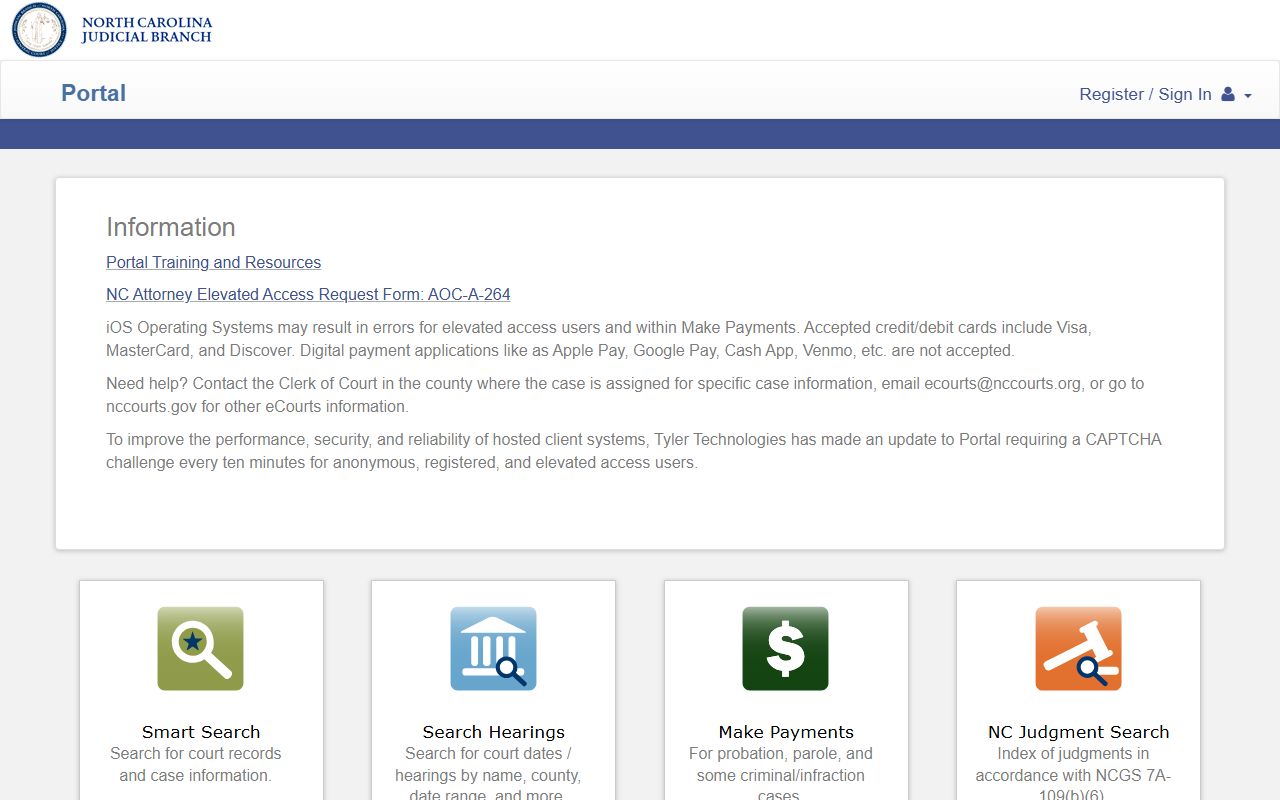
The portal screenshot is useful only after a case exists; it does not replace detention confirmation for a new jail booking.
Lenoir County Court Contacts
Local court contacts are central when online records lag behind a new arrest. The Lenoir County Courthouse main number and Clerk of Superior Court number are both listed as 252-520-5300. Magistrates are listed at 252-520-5430. The District Attorney appears in the Judicial Branch directory at 252-520-5400, while the Prosecutorial District 9 page lists district office contact information in Goldsboro and identifies the Lenoir County Courthouse at 130 South Queen Street in Kinston.
Lenoir County Clerk of Superior Court
Lenoir County Courthouse
Kinston, NC
252-520-5300
Magistrates
Lenoir County court release and appearance questions
252-520-5430
District Attorney
Prosecutorial District 9
252-520-5400
Charging Documents After Arrest
After a Lenoir County arrest, a charging document turns the accusation into a court case. North Carolina cases can involve complaints, informations, indictments, citations, warrants, or other charging papers depending on the charge and stage. The key point for readers is plain: the jail can reflect an arrest, but the court file controls the case record.
| Document | Who Uses It | What It Does |
|---|---|---|
| Complaint | Law enforcement or prosecutor path | States the accusation that begins or supports the case. |
| Information | Prosecutor path | Files a criminal charge without a grand-jury indictment where allowed. |
| Indictment | Grand jury path | Charges a felony or other matter after grand-jury action. |
Returned arrest and search warrants, indictments, criminal summonses, and certain orders are public court records under North Carolina law unless sealed by court order.
Lenoir County Charge Status
Charge status changes as a case moves. A first booking entry may use one description, while the prosecutor files another. Charges may also change after first appearance, plea negotiation, indictment, or dismissal. A court record should be read by charge, count, date, case number, and status.
| Status | Plain Meaning |
|---|---|
| Pending | The charge has not reached final disposition. |
| Amended | The filed charge changed from the earlier version. |
| Reduced | The charge was replaced by a lesser offense. |
| Dismissed | The court or prosecutor ended the charge without conviction. |
| Not guilty | The person was acquitted of that charge. |
| Guilty / responsible | The charge ended in adjudication through plea, verdict, or responsibility finding. |
Bond After Lenoir County Arrest
North Carolina release conditions are commonly set by a magistrate or judge depending on the stage and charge. Lenoir County research did not locate a sheriff page that publishes accepted bond payment methods, bond-window hours, or detailed bond-posting procedure. The safe route is to verify through the detention center, booking desk, magistrates, Clerk of Superior Court, or the case record. Commissary deposits through Access Corrections are not bond payments.
| Release Type | Meaning |
|---|---|
| Written promise | The defendant signs a promise to appear without depositing money. |
| Unsecured bond | No money is paid up front, but the amount may be owed after failure to appear or violation. |
| Secured bond | Cash, property, or surety must secure a stated amount before release. |
| Cash bond | Cash is posted according to court or jail procedure. |
| Surety bond | A licensed bail bond agent posts bond under a fee arrangement. |
| No-bond hold | Release is unavailable until a court order, hold, or legal condition changes. |
Warrants and Court Records
No official Lenoir County Sheriff's web warrant-search page was located. The Records Division page says telecommunicators process warrants, DCI entries, NCIC entries, wanted persons, and criminal history checks. The court-side route matters because returned arrest and search warrants are public court records unless sealed. A warrant hit should be checked with the issuing court, clerk, attorney, or law enforcement rather than treated as a full case result.
Kinston Police publishes a most-wanted or media-release page, and MobilePatrol store listings advertise warrants and most-wanted lists where agencies participate. Those tools are not a countywide warrant database. People trying to resolve a warrant should understand that contacting law enforcement or appearing at court may carry a risk of arrest.
Charges vs Convictions
An arrest and a charge are not the same as a conviction. A charge is an allegation filed in court. A conviction requires a guilty plea, verdict, or other adjudication. Public lookups should not treat a jail booking entry as a final criminal-history result.
| Question | Charge | Conviction |
|---|---|---|
| Stage | Filed accusation after arrest or warrant process | Final or adjudicated result |
| Can it change? | Yes, it may be amended, reduced, dismissed, or superseded | Changes only through court action or post-judgment relief |
| Where to verify? | NC eCourts, clerk file, DA or court notices | Final court disposition and eligible state criminal-history channels |
Sealed and Expunged Records
North Carolina public access has limits. Juvenile records, sealed matters, ongoing investigations, and confidential offender information may not be public. N.C. Gen. Stat. section 15A-146 covers expunction of charges dismissed or resulting in not-guilty findings. N.C. Gen. Stat. section 15A-153 describes the purpose and effect of expunction.
| Record Type | Effect | Limit |
|---|---|---|
| Sealed | Hidden from ordinary public access by court order | Access may remain for courts or agencies under specific rules |
| Expunged | Eligible public entries are cleared under statute | Eligibility depends on the exact charge, result, and court order |
Important: Expunction may affect official records, but it may not erase copies already taken by third parties.